
On August 25th a beekeeper in Ashcott, Somerset, identified Asian hornets hawking his bees. He sent a photo via the ‘Asian Hornet Watch’ app, and a team from the National Bee Unit (NBU) arrived the same day. They began searching for the nest using advanced technology, attaching a tracer to captured hornets. Hornets hunt within a radius of 700 meters of their nest, so the team could track the direction of flight, leading them to eventually locate and destroy the nest on August 28th.
Asian hornets, also known as yellow-legged hornets, are very aggressive. Their stings are extremely painful and lower the victim’s blood pressure. They can sting multiple times. Asian hornets predate on all insect life and their larvae can consume 12 – 13 kilos of insects in a season. They particularly target beehives, but they have the potential to devastate our entire insect population.
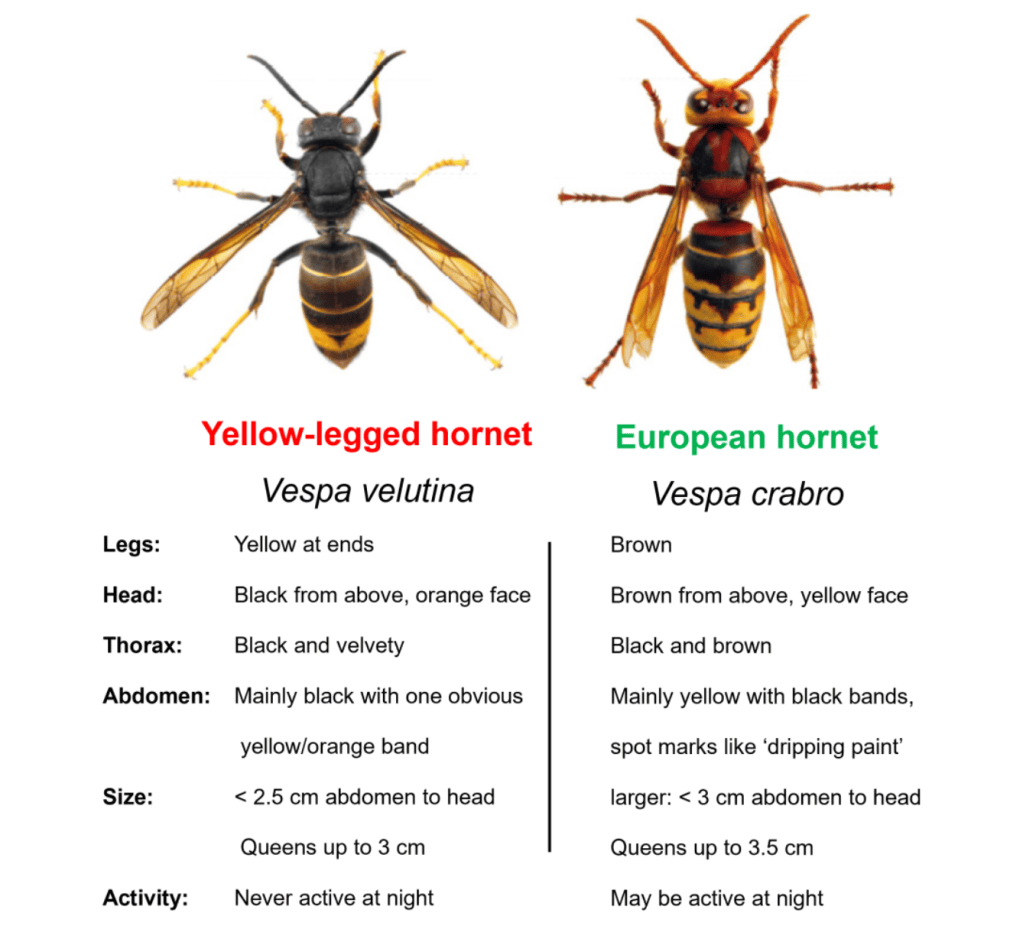
The ID comparison above is from the NBU website. It’s worth noting that the Asian hornet is slightly smaller than the European hornet. Full details on how to identify the Asian hornet may be found on the Non-Native Species website here.
Please familiarise yourself with what the Asian hornet insect looks like, and learn how to report a possible sighting. Our local insect population is at greater risk now the Asian hornet has made it to Somerset.
You can report any sighting of an Asian hornet via the Asian Hornet Watch app, available for both android and iPhone. Alternatively, you can email photos and videos to: alertnonnative@ceh.ac.uk. Please ensure you include your full location and contact details, as well as at least one photo of the hornet.
Sheila Conrad


You must be logged in to post a comment.